 News
A tree residents tie to Okomfo Anokye falls at Asante Agona, 152 years after Kumasi's
Videos shared on social media show a tree that people in Asante Agona say Okomfo Anokye planted in 1690 uprooted by strong winds on 3 November. In January 1874, a tree in Kumasi's market linked to him also fell.
On Tuesday 3 November 2026, strong winds ahead of rainfall uprooted a tree at Asante Agona, north-east of Kumasi, according to posts with video shared on social media. People there say the tree was planted by Okomfo Anokye in 1690. The original video is credited to @meyeasanteni and was shared on X by accounts including Ask Ghana Media and KMJ.
As of the morning of 4 November, no mainstream news outlet had reported the fall. The 1690 date is local tradition and could not be independently verified. Some people reacting to the posts said they saw the fall as a bad sign.
Who Okomfo Anokye was
Okomfo Anokye was a priest who, with Osei Tutu I, founded the Asante union around 1695 to 1701. His dates of birth and death are uncertain.
Tradition says he brought the Golden Stool down from the sky; another scholarly account says he made it. Tradition also says he planted kum seedlings at Kwaman, Dwaben and Kumawu, and that only the one at Kwaman lived, so the town was renamed Kumase, "under the kum tree". The 1911 Encyclopaedia Britannica gives a different explanation, linking the name to the number of such trees in its streets.
He became Agonahene, ruler of Agona, and his successors still hold the Agona stool, according to the Encyclopaedia Africana and a study in the Journal of African History. Tradition says he vanished at Agona Akyempim.
6 January 1874
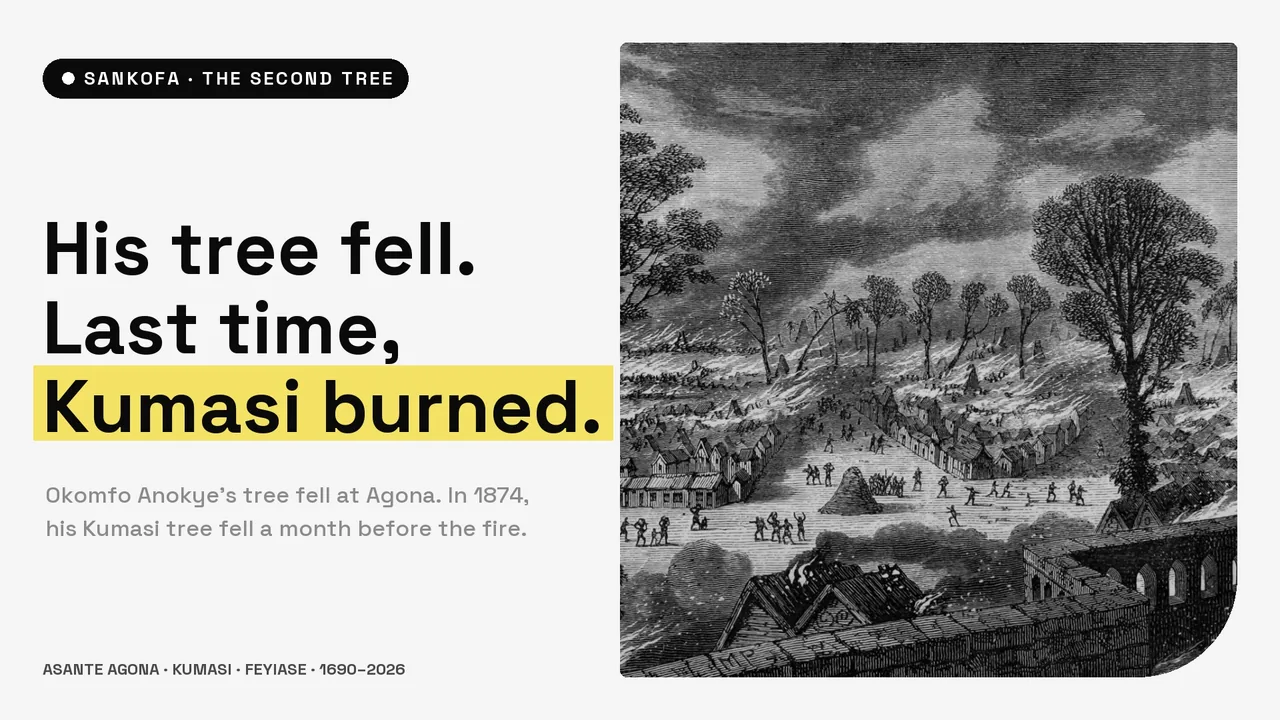
On Tuesday 6 January 1874, the holy tree in Kumasi's market place fell. Two Basel Mission missionaries held prisoner in the town, F. A. Ramseyer and J. Kühne, recorded it in their diary as "a bad sign", in their book Four Years in Ashantee (1875). The same book carries an account by the trader M.-J. Bonnat to Sir Garnet Wolseley that the great tree in Kumasi suddenly fell. The scholar Jan Platvoet, citing Gundert (1875), describes it as an ancient kum tree in Kumasi's Great Market, believed to have been planted by Anokye. What brought it down is not recorded.
A month later, between 4 and 6 February 1874, British troops under Wolseley took Kumasi, looted the palace and burned the city.
The Feyiase cola tree
In November 2023, a cola tree at Feyiase linked to the Okomfo Anokye legend was cut down at night, MyJoyOnline and GhanaWeb reported. Feyiase is the site where Asante defeated Denkyira in 1701. In December 2023, the Forestry Research Institute of Ghana (CSIR-FORIG), whose director Prof. Daniel Ofori spoke to MyJoyOnline, grafted and budded the stump, and Adom Online reported that it was growing again. Its current state is not known.
What is not yet known
QMS has not seen a statement from the Agona traditional authorities or from Manhyia Palace on the Agona tree, and it is not known whether replanting is planned.
Kumasi did not fall in 1874 because a tree fell. It fell to guns. The tree was not the cause; it was the witness. At Feyiase, scientists from CSIR-FORIG grafted a stump everybody had written off, and it sprouted. So don't just fear this one. Take a cutting and plant it again, right there in Agona.
- Ask Ghana Media on X, post with video (3 Nov 2026)
- KMJ on X, post with video (3 Nov 2026)
- F. A. Ramseyer and J. Kühne, Four Years in Ashantee (1875)
- Jan Platvoet, "Renewal by Retrospection" (1991), citing Gundert (1875)
- Encyclopaedia Africana: Okomfo Anokye
- Journal of African History: Komfo Anokye of Asante
- 1911 Encyclopaedia Britannica: Kumasi
- Wikipedia: Capture of Kumasi (1874)
- MyJoyOnline: Okomfo Anokye's historic cola tree felled in Feyiase (7 Nov 2023)
- GhanaWeb: Feyiase cola tree (10 Nov 2023)
- MyJoyOnline: slain cola tree gets new hope (23 Dec 2023)
- Adom Online: historic Okomfo Anokye cola tree grows anew (7 Dec 2023)
Every factual line in this story is checked against at least two independent sources, unless the text says it comes from one report.